
Visitor Access Without Turning Your Gate Into a Free-For-All
Picture this: a delivery driver buzzes the intercom at your office building's security gate. Someone at the front desk, halfway through a meeting and three tasks behind, hits the release without looking at the camera feed. The driver rolls a hand truck through the door. Behind him, a second person follows. Nobody stopped them. Nobody logged them. And now a stranger is inside a building where your badge-holding employees assume they are safe.
This is not a one-off failure. It is the default outcome when organizations invest in access control for employees and treat visitor management as an afterthought. Visitor workflows do not have the same procedural muscle memory that badge-in culture builds over time. They are improvised, inconsistent, and exploitable.
The uncomfortable truth is that most security programs have a visitor-shaped hole in them, and the people who know how to find holes know this one well. Sound visitor access control is not a feature add-on. It is a foundational requirement that most mid-size facilities still have not taken seriously.
Why Visitor Workflows Break Security Plans
Visitor access is where even well-designed security programs fall apart in practice. Policies that look airtight on paper collapse the moment a real person stands at the door, and a real employee has to make a real-time judgment call.
The gap between written policy and daily behavior is rarely intentional. Employees are not trying to compromise the building. They are busy, they are courteous, and they have been socially conditioned to hold doors open for people who look like they belong.
According to the ASIS International Foundation, social engineering, including tailgating and piggybacking, accounts for a significant share of unauthorized physical access incidents in commercial facilities. The attacker does not need to defeat your badge reader. They need someone inside to feel slightly awkward about not opening the door.
Staff ID badges compound the problem by creating a false sense of security. Your team's credentials are tightly managed. Provisioning, deprovisioning, access tiers, audit logs, the system is probably solid. But that investment stops at the employee boundary.
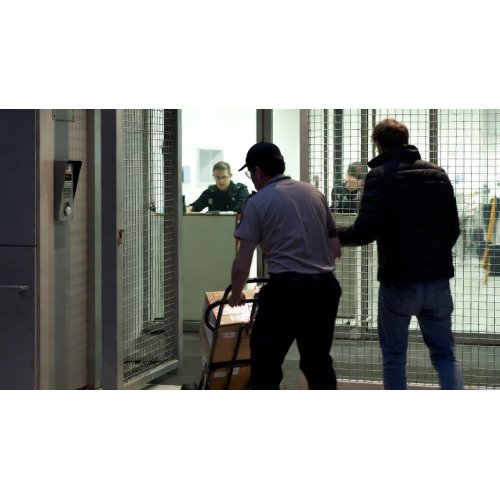 A well-secured office building security gate protects against the threats your system is designed to see. Visitors, contractors, and delivery personnel are invisible to it unless you build a separate control layer for them. Without one, every guest is a gap.
The Four Visitor Scenarios You Need a Policy For
Visitor access control failures cluster around four recurring scenarios. Each one has a different risk profile and a different set of controls. Treating them as a single problem produces a single, inadequate solution.
Scheduled Visitors and Guest Credentials
Scheduled visitors are the easiest population to manage and, because the tools exist, the least excusable to mishandle. The risk here is not usually a bad actor. It is credential persistence: a consultant who finished an engagement six months ago and whose temporary badge still works, or a visiting IT vendor whose access was never scoped to the rooms they actually needed.
The control architecture for scheduled visitors should include three components:
- pre-registration
- time-limited credentials
- automatic expiration
Visitors should be registered in your access management system before they arrive, not when they show up at the lobby.
Time-limited badges should be scoped to the access points the visit actually requires, nothing broader, and set to expire at the end of the scheduled appointment window. Most modern visitor management platforms support this natively. The NIST Special Publication 800-116 Rev. 1 on PIV credential management provides a useful federal framework for thinking about the access lifecycle, even for organizations not subject to federal requirements.
Delivery Drivers and Service Vendors
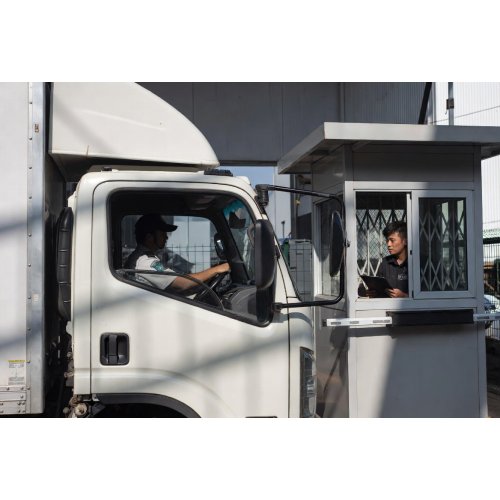
Delivery drivers and service vendors represent the highest-volume visitor category and the one most likely to be granted access habitually. The tailgating scenario described above almost always involves someone carrying something, a box, a toolbag, a clipboard, because physical load triggers a courtesy reflex that overrides procedural caution.
The rule for this category should be non-negotiable: no escort, no entry beyond the staging area. That requires two things the building may not currently have.
- A designated delivery and vendor staging area near the entrance, separated from the rest of the facility by a controlled access point.
- An intercom-plus-camera verification step before the outer door opens, so whoever grants access can actually see who they are letting in. The Security Industry Association (SIA) recommends integrating video verification with access grant decisions for all unescorted entry points as a baseline commercial practice. For high-traffic loading docks, scheduled delivery windows with vendor pre-registration are worth the operational overhead.
Unannounced or Walk-In Visitors
Unannounced visitors are the wild card. They include everyone from a job candidate who got the door time wrong to a former employee who still knows the building layout. The risk is not that all walk-ins are threats. The risk is that without a formalized intake process, you have no consistent way to distinguish between them.
Lobby intercoms are the first line of defense. A visitor should have to communicate with a person or a managed system before they can enter. That interaction should trigger a visitor log entry:
- Name
- Organization
- Host employee
- Time of arrival
- Purpose of visit
Paper logs are better than nothing. A digital visitor management system with photo capture and ID verification is substantially better. The U.S. Department of Homeland Security's Interagency Security Committee recommends visitor identification and logging as a baseline physical security measure for all federal-leased facilities and treats unannounced visitor intake protocols as a minimum standard. That benchmark is worth applying to commercial buildings regardless of tenancy type.
ADA and Accessibility Considerations
ADA compliance and physical security are not naturally aligned goals, and the tension is most acute at visitor entry points. The Americans with Disabilities Act requires accessible routes that do not impose additional burdens on people with disabilities. In practice, this often means a push-to-open door or an accessible gate alongside the primary controlled entry, and that secondary path is frequently the one with the least oversight.
The solution is not to remove the accessible entry. It is to put the same verification layer in front of it. Remote intercoms with video capability, mounted at accessible heights per ADA specifications, allow a staff member or automated system to verify the visitor and trigger the door remotely without requiring the visitor to navigate a standard credential reader. The ADA National Network provides guidance on accessible entrance design that can be cross-referenced with your access control architect. The goal is an entry point that is equally accessible and equally controlled, not a tradeoff between the two.
Building a Visitor Policy That Actually Gets Followed
Most visitor access control policies fail for one of three reasons:
- They are too complicated to execute in a real lobby environment
- Staff were never actually trained on them
- There is no enforcement mechanism when they are skipped
A policy that exists in a binder and is never followed is not a security control. It is a document with good intentions for security.
A functional visitor policy has four components.
- It defines who counts as a visitor, which matters more than it sounds because many organizations accidentally exempt contractors and vendors who should be subject to the same controls.
- It establishes entry and verification procedures for each visitor category, matched to the risk profile of that category.
- It assigns clear responsibility: who logs visitors, who issues credentials, who escorts, and who has the authority to deny entry.
- And it sets expiration and deprovisioning rules so access does not persist beyond its intended scope.
Technology should reinforce the policy, not replace it.
A visitor management platform is not a substitute for a trained front desk team. The most sophisticated intercom system in the market fails if the person monitoring it has been trained to wave people through. Invest in the workflow, not just the hardware. Run tabletop exercises that include visitor scenarios. Include visitor handling in your physical security awareness training. And review your visitor logs on a schedule, not just after an incident.
Take the Next Step Toward Safer Visitor Access
Visitor access is too important to leave to habit, guesswork, or a front desk employee making a split-second decision under pressure. The right access gate system can help your facility control who enters, document visitor activity, support staff workflows, and reduce the gaps that bad actors know how to exploit. If your gates, intercoms, access controls, or visitor entry points are not doing that today, Precision Garage Door can help you build a safer, smarter path forward. Contact Precision Garage Door today to discuss your access gate needs and take the next step toward a more secure facility.