
4 'Invisible' Electrical Problems Behind Every Flaky Commercial Gate
TL;DR
- If your commercial gate fails, works fine for a while, then fails again, that's not bad luck. That's a pattern.
- Most "random" gate failures trace back to one of four electrical issues: bad surge protection, poor grounding, a shared circuit, or a battery that's quietly dying.
- Skip commercial gate maintenance and you're not avoiding the cost of fixing it. You're just paying for it later, in service calls and downtime.
Here's a thing we hear a lot: "The gate's been acting up, but it's not consistent. Sometimes it works fine for a week, then it just stops." People tend to describe that as random. It almost never is.
Electrical systems don't usually fail cleanly. A wire either works or it doesn't, but the stuff around it, the boards, the sensors, the batteries, tends to degrade first and fail second. That in-between stage is where you get the weird, inconsistent behavior that looks random but is actually a system slowly falling apart. Ignore it long enough and the gate stops working for good, usually at the worst possible time.
Let's go through the four places this shows up most.
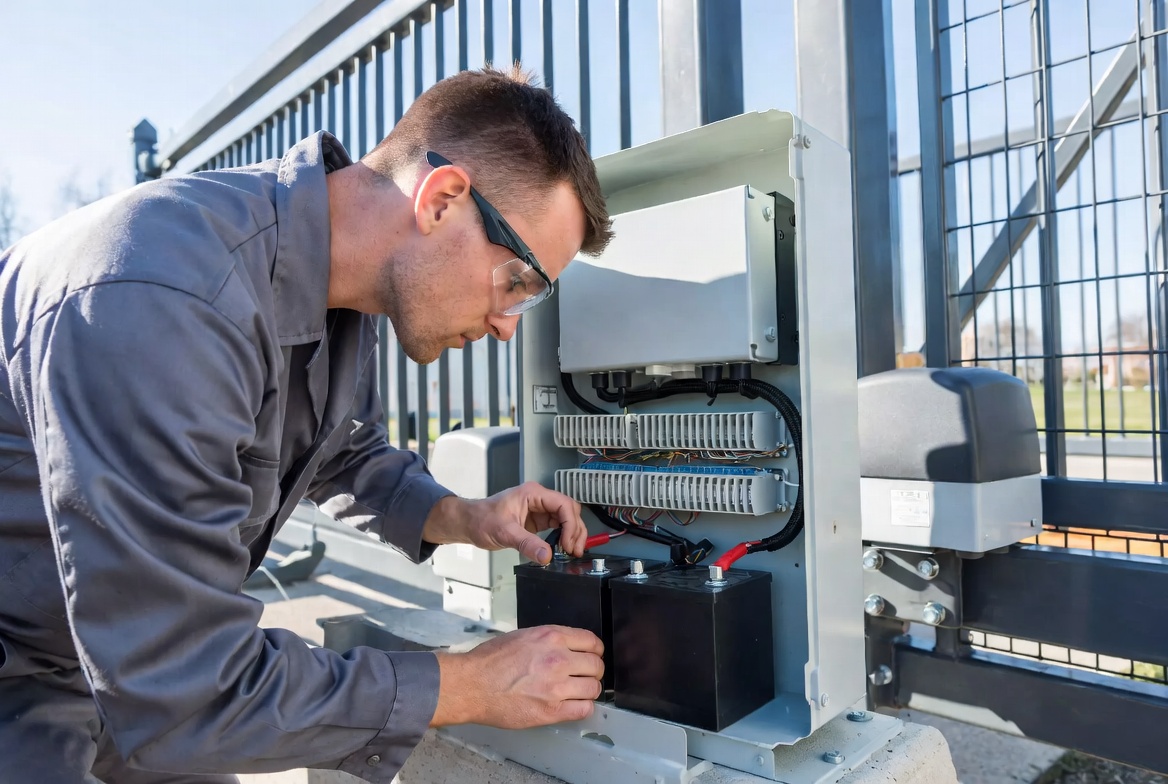
Surge Protection: Death by a Thousand Small Shocks
You'll usually notice it as the control board acting glitchy. The gate opens on its own, or it stalls halfway, or the remote works sometimes and not others.
Here's what's actually happening. A big power surge, like a lightning strike, will fry a board immediately and everyone knows to blame that. But most of the surges hitting your gate system aren't big. They're small voltage spikes from things like HVAC units cycling on, other equipment on the property switching on and off, that kind of thing. Each one is too small to notice on its own. But they add up, and over time they degrade the components on the control board, the same way bending a paperclip back and forth eventually snaps it.
That's exactly why it looks random. There's no single event to point to. The board isn't broken; it's wearing out, and it acts up more under certain conditions (heat, humidity, load) before it finally quits altogether.
Proper gate surge protection means a dedicated surge protective device installed at the gate operator, not just relying on whatever protection is built into the building's main panel. If your system doesn't have one, or it's an old one that's already taken a hit, that's the first thing worth checking.
Grounding: The Quiet Troublemaker
Symptom-wise, this one is sneaky. Sensors act flaky. The gate reverses for no reason. Sometimes it only happens after rain, or only in the mornings, or only when a truck drives past.
Grounding is supposed to give stray electrical current a safe path to go. When the ground isn't solid, whether that's corrosion, a loose connection, or a ground rod that was never installed to spec, that stray current has nowhere reliable to go. It ends up interfering with the low-voltage signals running the sensors and logic boards. Those are exactly the kinds of small currents that are easy to disrupt.
That's why weather and time of day matter so much here. Moisture changes how current behaves in soil and around connections. So a gate can run fine on a dry afternoon and misbehave the next morning after a storm, and it looks completely inconsistent even though the same underlying ground fault is causing it every time.
The fix is a proper ground fault check with a meter, not a guess. If it's been more than a couple of years since anyone tested the grounding on your system, and especially if you're seeing weather-linked glitches, that's worth putting on the list.
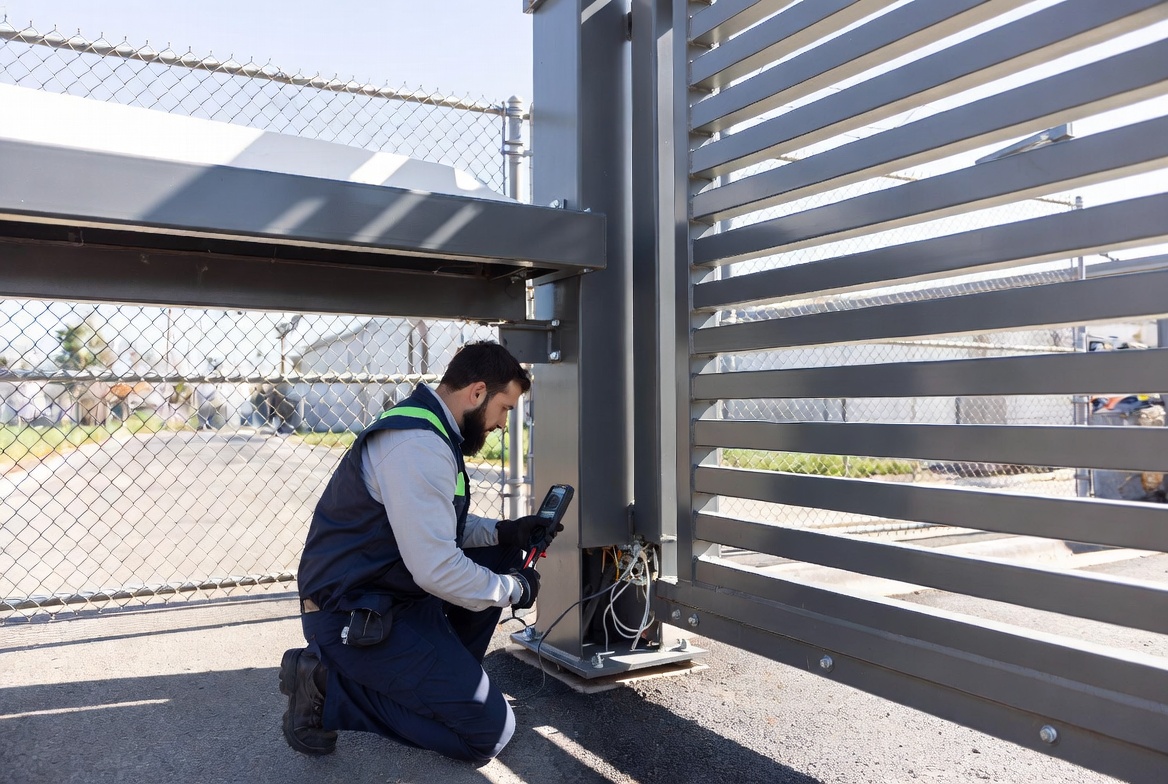
Shared Circuits: Borrowed Power, Borrowed Problems
This one usually shows up as failures that seem to line up with something else running on the property. The gate hesitates or drops out around the same time other equipment kicks on.
A lot of gates get wired onto whatever circuit was closest when the system was installed, instead of getting their own dedicated line. That's fine until something else on that circuit pulls a lot of power at once- a pump, a compressor, big HVAC equipment- and the voltage on the shared line dips for a second. Gate operators are sensitive to that. A brief voltage drop can be enough to reset the control board or throw a fault code, even though nothing about the gate itself changed.
Because the failure depends on what else is running at that exact moment, it can look completely unpredictable from the outside. It's not. It's just tied to somebody else's equipment cycle instead of the gate's own.
The real fix is a dedicated circuit for the gate operator. It's more work upfront, but it removes the guesswork entirely, and it's a standard part of commercial gate maintenance that's easy to overlook if the gate seemed to be working fine at install.
Batteries: Passing the Test, Failing the Job
This is the one that catches people off guard the most, because the gate seems totally fine, right up until the power blips and it just doesn't open.
Backup batteries get tested with a quick voltage check, and a degraded battery can still show a normal voltage reading while sitting there doing nothing. The real test is whether it can deliver enough current under actual load, which is a very different thing. A battery can pass the easy test and still fail the moment it's actually asked to do the job, which is exactly when you need it most.
That's why this failure feels so random. The gate can run perfectly for months on grid power, and the battery issue stays completely invisible until there's an outage or a brownout. Then, all of a sudden, it "randomly" won't open.
Batteries should get load tested, not just voltage checked, and most manufacturers recommend replacing them every 3 to 5 years regardless of how they test. If nobody can tell you the last time yours were swapped, assume it's overdue.
It All Comes Back to the Same Thing
Surge protection, grounding, shared circuits, batteries, four different parts, one shared pattern.
None of them tend to cause a single dramatic failure. They cause repeated, inconsistent problems that look random because the underlying issue is degrading quietly in the background instead of announcing itself.
That's the whole point of routine commercial gate maintenance. It's not about waiting for something to break and then fixing it. It's about catching the surge protection that's already taking small hits, the ground connection that's already corroding, the circuit that's already overloaded, and the battery that's already failing its real-world test, before any of it turns into a gate that won't open on a Monday morning with a line of cars behind it.
If your gate has been acting up in a way that seems inconsistent, that inconsistency is actually useful information. It's worth having someone check these four areas specifically rather than just resetting the system and hoping it holds. A short inspection now is a lot cheaper than an emergency call later, and it usually points straight to whichever one of these four is the real cause.