
Preventive Maintenance vs Break-Fix: The Real Cost Difference
TL;DR
When a commercial gate fails without warning, the real cost isn't just the repair bill. It's the hours your property sits vulnerable, the tenants or customers who can't get in, and the rush charges for parts you didn't have on hand. A commercial gate service plan trades that unpredictability for a fixed, manageable cost. Downtime is almost always more expensive than the maintenance contract that would have prevented it.

What's the Real Difference Between Preventive Maintenance and Break-Fix Repair?
Break-fix is exactly what it sounds like. Something breaks, you call someone, and you wait. There's no schedule, no advance notice, and no guarantee the technician who shows up has the part your gate actually needs.
Preventive maintenance flips that. A technician comes out on a set schedule, checks the parts that wear down over time, and fixes small issues before they turn into a gate that won't open on a Monday morning.
Both approaches cost money. The question isn't whether you'll spend on your gate system. It's whether you spend it on your terms or on the gate's terms.
What Is MTTR and Why Does It Matter for Gate Repairs?
MTTR stands for Mean Time to Repair. It's the average time it takes to get something broken back up and running, and it's one of the clearest ways to see the real gap between preventive and reactive maintenance.
With a service plan, MTTR is short and predictable. The technician already knows your equipment, already has your service history, and often has parts on the truck.
With break-fix, MTTR balloons. You're often calling a company that's never seen your gate before, explaining the make and model over the phone, and waiting for someone to become available. If it's after hours or a holiday weekend, add even more time.
Every hour your gate is down is an hour of exposure. Maybe that's a parking gate stuck open, letting anyone drive in. Maybe it's a security gate stuck closed, blocking deliveries or employee access. Either way, that downtime has a cost even if nobody sends you an invoice for it.
Why Do Spare Parts Make or Break Your Repair Timeline?
Here's something a lot of property managers don't think about until they're stuck: gate parts aren't always sitting on a shelf.
A commercial gate service plan usually includes access to common spare parts, either stocked on the technician's truck or held in reserve for your account. When something wears out, it gets swapped, not ordered.
Break-fix repair usually means the opposite. The technician shows up, diagnoses the problem, and then has to source the part. That could mean a few days. It could mean a couple of weeks if it's a less common component. During all of that, your gate stays down, and the daily cost of that downtime keeps adding up while you wait on a shipping label.
How Does Scheduled Testing Prevent Downtime Before It Starts?
Scheduled testing is the part of preventive maintenance that does the most quiet, unglamorous work. It's routine checks on safety sensors, entrapment protection, hinges, motors, and electrical connections, done on a set interval instead of whenever something finally fails.
This isn't just good practice. Automatic gate operators fall under UL 325, the safety standard covering gate operator systems, and gate construction is addressed under ASTM F2200. Regular testing is how a facility stays aligned with those standards and catches a failing sensor or a worn hinge before it becomes a liability issue, not just a maintenance one.
The gates that end up needing emergency repairs are almost always the ones that skipped this step. A five-minute test that catches a failing part in March is a lot cheaper than an emergency call in July.
What Does a Commercial Gate Service Plan Actually Include?
Coverage varies by provider, but a solid commercial gate service plan typically includes:
- Scheduled inspections and testing on a set interval (often quarterly)
- Lubrication and adjustment of moving parts
- Safety sensor and entrapment protection checks
- Priority response if something does break between visits
- Access to spare parts without a separate procurement delay
- A documented service history for compliance and insurance purposes
That last point matters more than people expect. If there's ever an incident involving your gate, a documented maintenance history is exactly what you want on file.
So What's the Real Cost Difference?
Run the math over three years and it usually looks like this: a service plan is a predictable, budgeted cost. Break-fix is a series of unpredictable costs, and each one tends to be higher than the last, because the parts that fail after long-term neglect are often bigger and more expensive than the ones that get caught early.
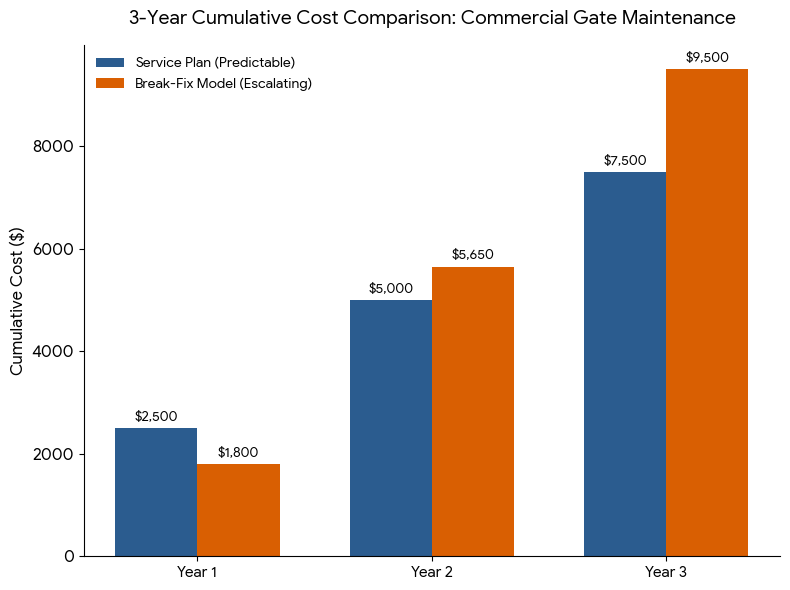
Add in the cost of downtime itself, whether that's lost tenant access, a security gap, or a blocked loading dock, and gate maintenance costs under a break-fix model almost always come out higher than the contract that would have prevented the failure in the first place.
What Should You Do Next?
If your gate is currently running on break-fix, the fastest way to see the difference is to get a look at what a service plan would actually cost for your specific gate system. That number is usually a lot smaller than people expect, especially next to the cost of a single emergency call.
Reach out for a maintenance assessment and get a real comparison based on your equipment, not a general estimate.